



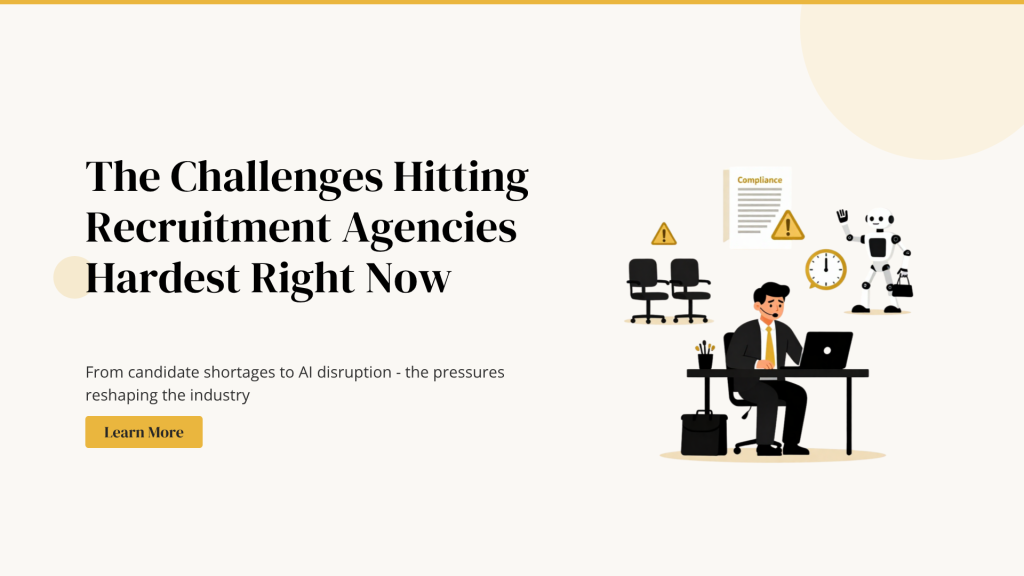
Recruitment challenges remain a major concern for agencies despite signs that the market is recovering. The recruitment industry has technically turned a corner. Year-on-year growth is back, the worst of the post-pandemic correction appears to be behind us, and most forecasts for 2026 are cautiously optimistic
However, if ask any agency owner how the year actually feels on the ground, and the answer can vary significantly.
The gap between the macro picture and the day-to-day reality is where the real story lives. Here are the six recruitment challenges we’re seeing agencies navigate most right now, and why each one is harder than it looks from the outside.
Challenge #1: Business Development Fatigue (When the Pipeline Takes Longer Than Ever to Convert)
Business development has always been part of the job. However, sales cycles have stretched significantly in ways that are quietly exhausting even the most seasoned agency leaders.
Today 83% of agencies need between one and six months to close a new client and that’s assuming consistent follow-up, which is where many firms fall down. Research suggests 44% of salespeople give up after a single follow-up, in an environment where multiple touchpoints are now the baseline expectation just to get a response.
Client ghosting, which was once a candidate problem, has migrated into business development. Decision-making processes are longer, procurement is more involved, and the people agencies used to reach directly are now harder to access.
The result is that BD activity is up, but conversion is down. For agencies already running lean, that’s a morale and margin problem at the same time.
Challenge #2 Compliance Complexity
For agencies placing workers across multiple US states, compliance has always been a background concern. In 2026, it continues to be a front-and-centre operational challenge and for many firms, a direct blocker on growth.
More than 50 new workplace laws took effect on 1 January 2026 alone, across over half the states in the country. Minimum wage increases, new paid leave programmes, AI hiring disclosure mandates, and pay transparency requirements – all state-specific, all effective simultaneously. The compliance calendar doesn’t stop there. States pass employment laws throughout the year, with effective dates scattered across every quarter.
A March 2026 study found that 50% of multi-state employers have directly turned down a qualified candidate due to compliance concerns tied to their state – often late in the process, after significant time has been invested on both sides. A further 43.7% admitted to quietly ruling out candidates in certain states without even informing them why.
For staffing agencies, who carry compliance obligations not just for their own employees but for every placed worker in every jurisdiction they operate in, that complexity compounds fast.
This is precisely where an Employer of Record earns its place. Rather than building compliance infrastructure across every state you operate in, an EOR carries that responsibility on your behalf – tracking legislative changes, managing jurisdiction-specific obligations, and absorbing the liability.
Challenge #3: AI-Generated CVs (More Volume, Less Signal)
In theory, having more candidates in the pipeline sounds like a good thing. In practice, the volume surge most agencies are experiencing in 2026 is creating more work, not less, because the quality signal has collapsed.
AI tools have made it trivially easy for candidates to generate polished, tailored applications at scale. What used to be a CV that took an afternoon to write now takes minutes. The result is that recruiters are sifting through significantly higher application volumes while finding it increasingly hard to distinguish genuinely strong candidates from well-optimised ones.
The problem is compounded by the fact that AI can now pass many first-round screening tools, which means the filtering mechanisms agencies rely on are less reliable than they were two, three years ago. Screening processes that were designed for a different volume of applications are now genuinely struggling. As one industry report put it, this isn’t a pipeline problem – it’s a signal-to-noise crisis.
Challenge #4: Low Voluntary Turnover
Here’s a dynamic that doesn’t make headlines but is having a real impact on candidate pipelines – workers have stopped moving.
U.S. voluntary turnover has fallen sharply from its post-pandemic peak of 24.7% in 2022 to 13% in 2025, and this trend has continued into 2026. The reasons are largely behavioural: economic uncertainty, concern about job security, and a preference for stability over risk are keeping workers in their current roles. Surveys suggest around 73% of U.S. workers plan to stay put, prioritising flexibility and company culture over new opportunities.
For an industry that relies on turnover to generate candidate supply, this is a structural headache.
The practical effect is that sourcing has become harder even in sectors where demand is healthy. Agencies that built their candidate generation model around inbound applications are finding that model significantly less productive than it was. Those investing in proactive outreach, long-term talent community building, and genuine relationship development are better placed, but it takes time that most desks don’t have.
Challenge #5: Clients in ‘Wait and See’ Mode
If macro jobs numbers look reasonable, unemployment is stable, and new positions are being created, why do so many agency recruiters feel like they’re working harder for fewer mandates?
The answer lies in where the caution is concentrated, clients are not stopping all hiring, but they are making very deliberate decisions about what type of hiring they commit to. Permanent headcount is the first casualty of uncertainty. It carries long-term cost obligations, redundancy risk, and is visible on a balance sheet in ways that contract and contingent arrangements are not.
New permanent requisitions are increasingly requiring senior sign-off, with longer internal approval cycles before an agency is even briefed. By the time a mandate arrives, it has often been through multiple rounds of internal debate and can be pulled just as quickly.
The silver lining for agencies that have a contract offering is real. Clients who won’t sign off on a permanent hire will often approve a three-month contract to solve the same problem. The challenge is that agencies built primarily around permanent placement are experiencing this shift as pure revenue pressure, rather than as an opportunity to rebalance their model.
Why perm-only recruiters should venture into the US contract market in 2026
Challenge #6: Tariff Uncertainty And The Manufacturing Ripple Effect
For agencies working in or adjacent to manufacturing, logistics, and industrial sectors, tariff policy has become an unpredictable variable in almost every client conversation.
U.S. manufacturing is under direct pressure from ongoing trade policy uncertainty. And often when uncertainty rises, hiring is usually the first thing to pause.
The impact is not uniform, some manufacturers are reshoring operations, which creates domestic hiring demand, but often for highly specialized, technical roles that are already hard to fill. Others are absorbing cost increases by reducing headcount or delaying expansion, which removes mandates from the pipeline entirely. The unpredictability is itself the problem – clients cannot plan confidently, which means they cannot commit to hiring timelines, which means agencies are holding conversations that don’t convert to roles.
The broader shift this is driving – from permanent to contingent – mirrors what’s happening with ‘wait and see’ clients more generally. Contract staffing insulates agencies somewhat from this volatility, because clients who won’t commit to permanent headcount will still engage flexible workers to maintain operational output.
What These Challenges Have in Common
If you look across these six difficulties and a common thread emerges – they are not problems that resolve themselves when the market improves. Low voluntary turnover is a structural behavioural shift. Multi-state compliance complexity is only going to increase. AI-generated applications are not going away. Business development cycles have been reset by procurement involvement and internal AI tooling.
The agencies building resilience in this environment are the ones making structural adjustments: diversifying into contract, investing in compliance infrastructure, rebuilding candidate generation strategies for a market where supply is tighter than it looks, and treating business development as a long-cycle discipline rather than a quick-win activity.